For a Left Populism by Chantal Mouffe
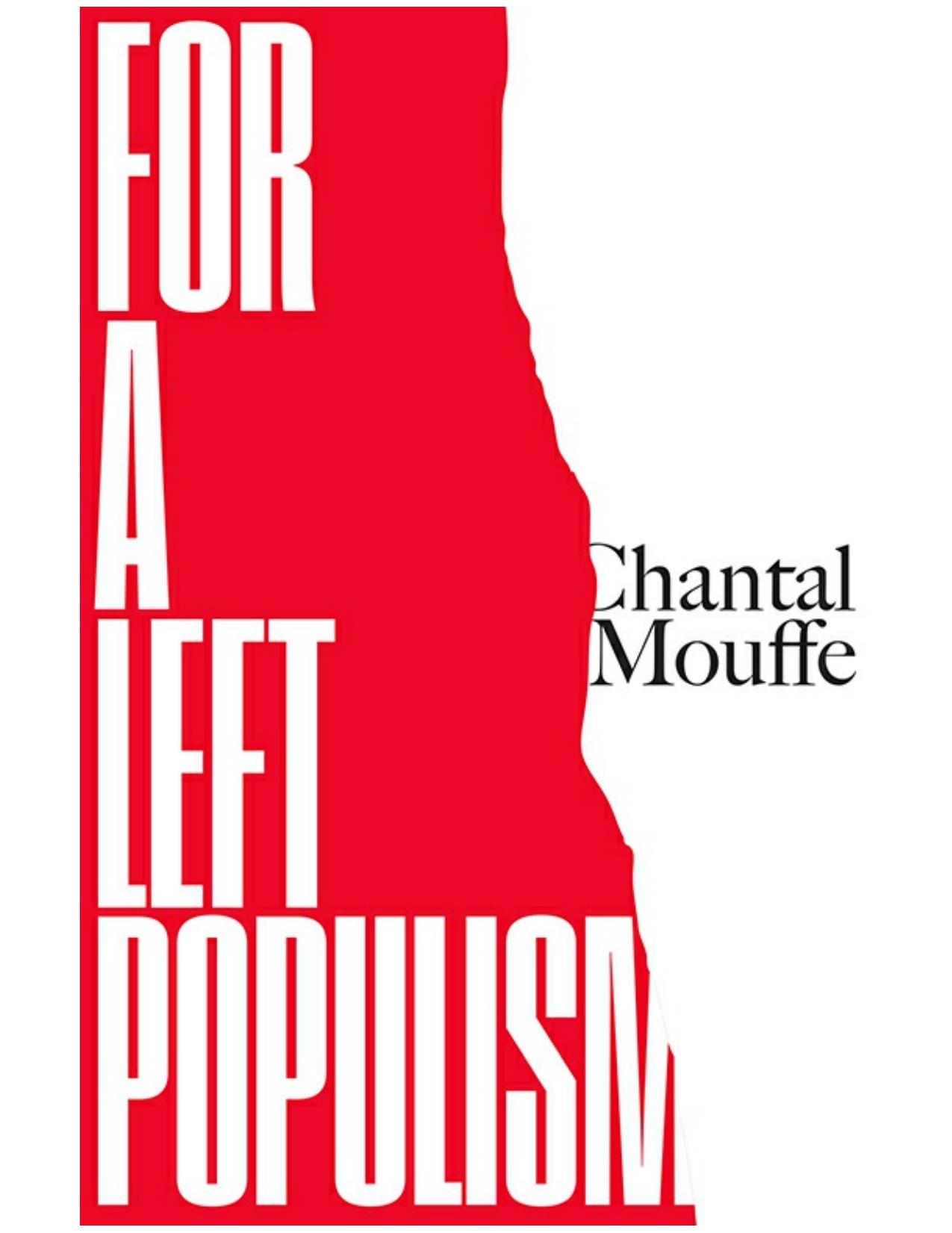
Author:Chantal Mouffe
Language: eng
Format: epub, pdf
Publisher: Verso Books
They claim, thanks to this reversal, to be able to avoid the problem facing all types of populism, both from the left and from the right, which are ‘characterized by a central paradox: constant lip service to the power of the people but ultimate control and decision-making by a small clique of politicians’.9
Central to the perspective of Hardt and Negri is the notion of ‘the common’, which, defined in contrast to property both private and public, constitutes the linchpin of their approach. In this respect Assembly follows their previous analyses in Commonwealth, where they argue that bio-political production creates the condition for a democracy of the multitude because it produces the forms of economic and political subjectivities that are an expression of ‘the common’. As labour is increasingly responsible for generating cooperation without the need for the intervention of capital, bio-political production brings with it new democratic capacities. According to them a society built on the principle of ‘the common’ is therefore already evolving through the processes of informatization and the development of cognitive capitalism.
Independently of the value of their analysis of the productive process, which has been criticized from many quarters, what I find problematic in their celebration of ‘the common’ is the idea that it might provide the main principle of organization of society. The central problem with this celebration of ‘the common’, which is found, albeit in different forms, in the work of many other theorists is that, by postulating a conception of multiplicity that is free from negativity and antagonism, it does not make room for the recognition of the necessarily hegemonic nature of the social order. In the case of Hardt and Negri, their refusal of representation and sovereignty proceeds from an immanentist ontology that is clearly in contradiction with the one that informs my conception of radical democracy.
One can also find a critique of representation in another proposal to radicalize democracy. In this case the ancient practice of selection by lot, sortition, is presented by a variety of theorists as providing the remedy to the crisis of representation currently affecting our democratic societies. Such proponents claim that representative democracy has been invented to exclude the people from power and that the only way to establish a real democratic order is to abandon the electoral model and replace it with a lottery.10
This view is flawed because it reduces representation to elections and does not acknowledge the role of representation in a pluralist democracy. Society is divided and crisscrossed by power relations and antagonisms, and representative institutions play a crucial role in allowing for the institutionalization of this conflictual dimension. For example, in a pluralist democracy, political parties provide discursive frameworks that allow people to make sense of the social world in which they are inscribed and to perceive its fault lines.
If we accept that the consciousness of the social agent is not the direct expression of their ‘objective’ position and that it is always discursively constructed, it is clear that political subjectivities will be shaped by competing political discourses and that parties are essential in their elaboration.
Download
This site does not store any files on its server. We only index and link to content provided by other sites. Please contact the content providers to delete copyright contents if any and email us, we'll remove relevant links or contents immediately.
| Anarchism | Communism & Socialism |
| Conservatism & Liberalism | Democracy |
| Fascism | Libertarianism |
| Nationalism | Radicalism |
| Utopian |
The Secret History by Donna Tartt(19048)
The Social Justice Warrior Handbook by Lisa De Pasquale(12187)
Thirteen Reasons Why by Jay Asher(8893)
This Is How You Lose Her by Junot Diaz(6877)
Weapons of Math Destruction by Cathy O'Neil(6264)
Zero to One by Peter Thiel(5786)
Beartown by Fredrik Backman(5737)
The Myth of the Strong Leader by Archie Brown(5498)
The Fire Next Time by James Baldwin(5431)
How Democracies Die by Steven Levitsky & Daniel Ziblatt(5213)
Promise Me, Dad by Joe Biden(5141)
Stone's Rules by Roger Stone(5081)
A Higher Loyalty: Truth, Lies, and Leadership by James Comey(4951)
100 Deadly Skills by Clint Emerson(4920)
Rise and Kill First by Ronen Bergman(4779)
Secrecy World by Jake Bernstein(4740)
The David Icke Guide to the Global Conspiracy (and how to end it) by David Icke(4701)
The Farm by Tom Rob Smith(4502)
The Doomsday Machine by Daniel Ellsberg(4484)
